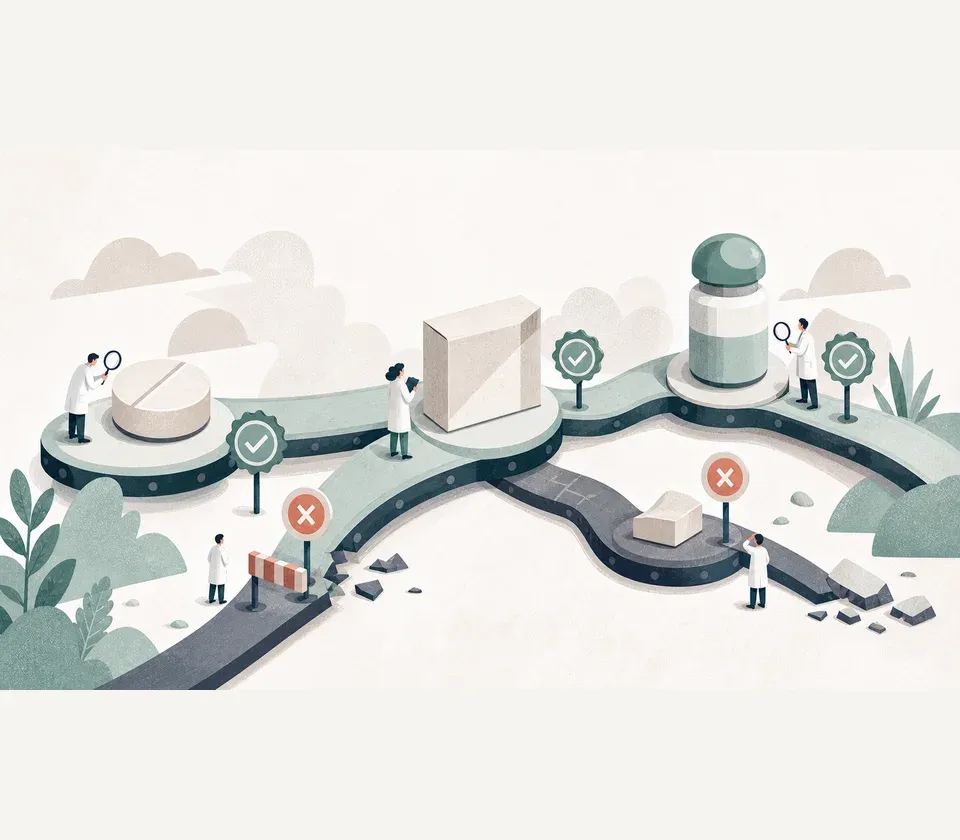
Evidence reviewed
Original brand name
ReVia (Naltrexone)
The original oral naltrexone brand, developed by DuPont and FDA-approved in 1984. ReVia is naltrexone hydrochloride 50 mg tablets — the same active ingredient as all generic oral naltrexone. Brand discontinued in the US but the name remains the most recognised reference for oral naltrexone.

What is ReVia?
ReVia (naltrexone hydrochloride tablets USP) is the original brand name for oral naltrexone. It is a 50 mg film-coated scored tablet — the standard form of oral naltrexone used worldwide for alcohol and opioid dependence treatment.
ReVia is naltrexone. There is no difference in active ingredient between ReVia and generic naltrexone tablets. ReVia is the brand; 'naltrexone' is the drug name. When you see references to oral naltrexone on this site — the 50 mg tablets taken daily, the medication used in the Sinclair Method, the PBS-subsidised option in Australia — that is the same naltrexone hydrochloride that was originally branded as ReVia.
The ReVia brand name has been discontinued in the United States. Generic naltrexone tablets manufactured by multiple pharmaceutical companies (Teva/Barr, Mallinckrodt, Accord, Apotex, and others) are the standard dispensing form in the US and most countries today. However, the name 'ReVia' remains deeply embedded in medical literature, clinical guidelines, and patient experience — it is still commonly referenced by doctors and pharmacists.
Brand history
The evolution of ReVia
From laboratory synthesis to worldwide generic availability.
1963
First synthesised
Naltrexone was created at Endo Laboratories as researchers explored opioid antagonist compounds for addiction treatment.
1969
Acquired by DuPont
Endo Laboratories was acquired by DuPont, which continued development of naltrexone for FDA approval.
1984
FDA approval as Trexan
FDA approved naltrexone for opioid dependence under the brand name Trexan. DuPont promoted the medication to addiction treatment programmes.
1994
Renamed ReVia for alcohol
With FDA approval for alcohol dependence, DuPont renamed the brand from Trexan to ReVia. The active ingredient was identical — only the brand name and indication changed.
1997
Market exclusivity lapses
Generic competition became possible. Barr Laboratories produced the first generic naltrexone in 1998.
2001–2002
Bristol-Myers Squibb → Barr
BMS acquired DuPont Pharmaceuticals in 2001; in 2002 sold ReVia US/Canada rights to Barr Laboratories (now part of Teva Pharmaceuticals).
Today
Generic naltrexone worldwide
ReVia brand discontinued in the US. Generic naltrexone 50 mg tablets manufactured by multiple companies (Teva, Mallinckrodt, Accord, Apotex, Sandoz, and others) available in most countries. ReVia name still recognised in clinical practice and occasionally available in some markets.
ReVia vs. other naltrexone forms
How ReVia (oral naltrexone) relates to the other naltrexone-containing products.
ReVia = oral naltrexone
ReVia is naltrexone hydrochloride 50 mg tablets taken once daily by mouth. It blocks opioid receptors for 24–72 hours per dose. This is the standard oral form used in the Sinclair Method, daily relapse prevention, and most clinical trials. Generic versions are chemically identical and therapeutically equivalent.
ReVia ≠ Vivitrol
Vivitrol is naltrexone extended-release injectable suspension 380 mg, administered monthly into the gluteal muscle by a healthcare provider. It contains the same active ingredient (naltrexone) but in a microsphere formulation that releases slowly over 28–30 days. ReVia is a daily tablet; Vivitrol is a monthly injection. Both are for addiction treatment.
ReVia ≠ Contrave
Contrave combines naltrexone 8 mg with bupropion 90 mg for weight management. It contains a much lower dose of naltrexone (32 mg/day at full dose vs. 50 mg/day for ReVia) plus an antidepressant component. Contrave is NOT for addiction treatment — it is a distinct product for a different indication.

ReVia: key facts
Data from FDA labelling, DuPont clinical trials, and prescribing information.
- First FDA approval
- 1984
- Standard dose
- 50 mg
- Abstinence rate
- 51% vs 23%
- Available as generic
- Generic
Approved as Trexan for opioid dependence. Renamed ReVia in 1994 for alcohol
Single tablet taken once daily. Initial dose 25 mg for first day to test tolerance
ReVia vs. placebo in the landmark 12-week clinical trial (Volpicelli et al., 1992)
Multiple manufacturers worldwide. No meaningful clinical difference from branded ReVia
Common questions about ReVia
Can I still get ReVia brand-name tablets?
In the United States, the ReVia brand has been discontinued. Pharmacies dispense generic naltrexone tablets which are chemically identical (same active ingredient, same strength, same clinical effect). In some countries outside the US — particularly in Europe — the ReVia name may still appear on branded tablets, though this is increasingly rare. If your prescription says naltrexone or ReVia, you will almost certainly receive generic naltrexone 50 mg tablets. There is no therapeutic difference.
What does a ReVia tablet look like?
The original ReVia tablet was a beige, round, biconvex, film-coated scored tablet with 'REVIA' debossed on one side and a stylised 'b/275' on the scored side. It was supplied in bottles of 30 tablets (unit-of-use) or 100 tablets. Generic naltrexone tablets vary in appearance by manufacturer but are the same 50 mg dose.
Is ReVia the same as naltrexone?
Exactly the same. ReVia is a brand name for naltrexone hydrochloride 50 mg tablets. There is no difference in the active ingredient, dose, mechanism of action, indications, or clinical effects. The name ReVia is to naltrexone what Panadol is to paracetamol — one is the brand, the other is the drug name.
Who manufactured ReVia?
ReVia was initially developed by DuPont Pharmaceuticals (which acquired Endo Laboratories, the original synthesizer in 1963). DuPont formed DuPont Merck in 1991. Bristol-Myers Squibb acquired DuPont Pharmaceuticals in 2001. Barr Laboratories (now part of Teva Pharmaceuticals) acquired the US and Canadian ReVia rights from BMS in 2002. Generic manufacturers worldwide — Teva, Mallinckrodt, Accord, Apotex, Sandoz, INTAS, and others — produced generic naltrexone after market exclusivity lapsed in 1997.
What dose of ReVia is used for alcohol dependence?
The FDA-approved dosing for alcohol dependence is 50 mg once daily. Treatment typically begins with 25 mg on day 1 (to test tolerance and confirm no precipitated opioid withdrawal) and increases to 50 mg daily from day 2 onward. The placebo-controlled trials used 50 mg once daily for 12 weeks. The COMBINE Study (2006) found that higher doses (100 mg daily) were also effective and well-tolerated, with over 85% adherence in a 16-week trial. Three-times-weekly dosing (e.g., 100 mg Mon/Wed, 150 mg Fri) has been used to improve compliance while maintaining blockade.
Is ReVia addictive?
No. Naltrexone (ReVia) is not habit-forming. It does not produce euphoria, tolerance, physical dependence, or withdrawal symptoms upon discontinuation. It is an opioid antagonist — it blocks rather than activates opioid receptors. You can stop taking it at any time without a withdrawal period. This is a key safety advantage compared to opioid replacement therapies like methadone or buprenorphine.
ReVia is naltrexone. Here is where to get it.
Generic naltrexone 50 mg tablets (the same medication as ReVia) are available by prescription in every country covered by this site. Choose your location for access, costs, and prescribing details.
Primary product and trial records
- FDA ReVia prescribing information
50 mg formulation, tablet description, pivotal alcohol-dependence results, and safety-study population.
- FDA approval package: first Barr generic, ANDA 074918
Identifies ReVia, formerly Trexan, as the reference product and records the generic application.
- DailyMed search: current naltrexone tablet labels
Use to verify current US labelers and marketed presentations.